

Oct, 2026
AI Digital Employees and Human Talent: The Power of Getting the Balance Right

Synergy Group AI Team
How businesses can unlock the full potential of AI by combining digital efficiency with human expertise.
Artificial intelligence is changing the way businesses operate, serve customers, and support their employees. From answering questions around the clock to helping teams work more efficiently, AI digital employees are creating opportunities that would have seemed unimaginable just a few years ago.
Yet, despite all the excitement surrounding AI, one important question remains: Are businesses using this technology in the right way?
For some organizations, AI adoption is primarily about reducing costs, automating tasks, and handling more interactions without increasing headcount. While these benefits can be significant, they represent only part of the opportunity.
The real value of AI digital employees emerges when companies understand where they can make the greatest difference, how they complement human employees, and when a personal interaction is still the best solution.
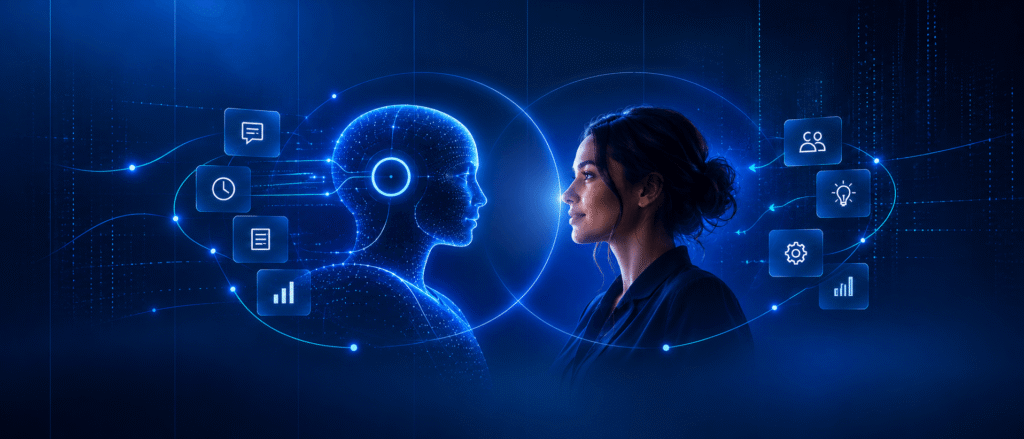
The future isn’t about choosing between AI and people. It’s about bringing them together in a way that makes businesses more efficient, employees more effective, and customer experiences better.
AI Digital Employees Can Deliver Real Business Value
Imagine a business where customers can get answers at any time of day, routine requests are handled in seconds, and employees spend less time searching for information or repeating the same tasks.
That is one of the most practical benefits AI digital employees can offer.
Unlike human employees, AI digital employees can support many routine interactions simultaneously and provide consistent assistance across a range of common requests. Depending on their capabilities and integration with business systems, they can help customers find information, navigate processes, check account details, and complete certain tasks without waiting for a representative to be available.
For businesses operating across multiple time zones or managing high volumes of customer inquiries, this can make a meaningful difference.
Customers get faster access to assistance. Employees face fewer repetitive requests. And organizations can use their existing workforce more effectively.
AI can also help internal teams. Digital employees can assist with locating policies, answering routine employee questions, summarizing information, and guiding people through established workflows.
Instead of spending valuable time searching for answers or navigating complex processes, employees can focus on responsibilities that require their expertise.
These benefits can translate into improved productivity, greater service availability, and more efficient operations.
However, the technology alone does not guarantee these outcomes. The results depend on how well companies identify the right use cases, connect AI to reliable information, establish appropriate safeguards, and design experiences around real customer and employee needs.
In other words, implementing AI is only the beginning. Knowing how to use it effectively is what creates value.
The Difference Between Automating Tasks and Improving Experiences
One of the most common mistakes businesses can make is treating automation as the ultimate measure of AI success.
It is easy to celebrate a reduction in calls, a higher automation rate, or fewer requests reaching human employees. These numbers can indicate progress, but they don’t necessarily tell us whether the customer experience has improved.
Consider two customers contacting a company about a billing question.
The first interacts with an AI digital employee that quickly retrieves the relevant information, explains the charges, and resolves the question. The customer gets what they need without waiting in a queue.
The second encounters an automated system that misunderstands the question, provides irrelevant information, and makes it difficult to reach a human representative.
Both interactions may have started with AI. Only one delivered a genuinely good experience.
This is why businesses need to look beyond the number of interactions AI handles and focus on what those interactions achieve.
A well-designed AI digital employee should resolve the requests it is equipped to handle, recognize its limitations, and make it easy to involve a human employee when necessary.
When companies get this right, automation becomes more than a cost-saving mechanism. It becomes a way to remove friction, improve access to information, and make service more convenient.
The objective isn’t to automate every interaction. It’s to use AI wherever it creates a better outcome.
Finding the Right Balance Between AI and Human Employees
AI digital employees and human employees bring different strengths to the workplace.
AI is particularly useful for repetitive tasks, information retrieval, routine transactions, and providing consistent support at scale. Human employees bring contextual understanding, empathy, creativity, negotiation skills, and judgment in situations that require a more personal approach.
The opportunity lies in combining these strengths.
In customer service, for example, an AI digital employee can handle common questions about orders, account information, or standard policies. When a customer has a complicated complaint or needs help with an unusual situation, a human representative can take over.
The transition should feel natural. The employee should receive the relevant conversation history and information already collected, so the customer doesn’t have to explain everything again.
In sales, AI can help organize customer information, prepare summaries, and identify relevant details before a meeting. The sales professional can then use that information to have a more informed conversation and build a stronger relationship.
Within human resources, AI digital employees can answer routine questions about company policies, benefits, and internal processes, allowing HR professionals to spend more time on employee development, sensitive concerns, and strategic initiatives.
Across these scenarios, AI handles work that can be handled efficiently through digital assistance, while people remain available for situations where human involvement adds meaningful value.
This balance shouldn’t be rigid. As AI capabilities evolve, businesses should regularly review which tasks can be automated safely, which require human oversight, and which are best handled through collaboration.
The right model is the one that serves the customer, supports employees, and achieves the business objective.
AI Can Improve the Work Experience for Human Employees
The value of AI digital employees extends beyond customer service.
They can also change how employees experience their own workday.
In many organizations, talented people spend a surprising amount of time on repetitive administrative tasks, searching for information, answering the same questions, or navigating disconnected systems.
These activities are often necessary, but they don’t always make the best use of an employee’s skills.
AI can help reduce some of this burden.
Imagine a customer service representative who receives a conversation summary before speaking with a customer. Instead of spending the first few minutes collecting basic information, the representative can focus immediately on the issue.
Imagine a manager who can quickly locate relevant internal policies or an employee who can get guidance on a routine process without waiting for another team to respond.
These may seem like small improvements, but across a large organization, they can create meaningful efficiencies.
More importantly, they can give people more time to focus on work that requires their knowledge, judgment, and creativity.
For this to happen, companies must position AI as a tool that supports employees rather than simply a mechanism for measuring productivity or reducing staffing.
Employees should receive appropriate training, understand how AI fits into their roles, and have a voice in how the technology is introduced.
When people understand the purpose of AI and see how it makes their work easier, adoption is more likely to become part of everyday business operations.
Knowing When AI Should Step Aside
Successful AI adoption isn’t only about knowing what technology can do. It also requires recognizing when a human interaction is the better choice.
Not every customer wants to interact with AI in every situation. Some questions are straightforward, while others involve frustration, uncertainty, financial concerns, or personal circumstances that require greater sensitivity.
Businesses need to design their AI experiences around these differences.
An AI digital employee should be able to recognize when a request falls outside its capabilities, when information is insufficient, or when a conversation needs human attention.
Customers should have a clear path to speak with someone, especially when an issue cannot be resolved through automation.
Human escalation is not necessarily a failure of AI. In many cases, it is evidence that the system is being used responsibly.
The same principle applies internally. AI can provide information and recommendations, but employees need clear guidance about when to verify an answer, exercise independent judgment, or seek specialist assistance.
This is particularly important when decisions involve sensitive information, significant financial consequences, or other high-stakes outcomes.
Trust depends on getting these boundaries right.
Companies that try to force every interaction through AI risk frustrating customers and employees. Companies that use AI selectively and intelligently can deliver faster service without losing the personal connection that builds lasting relationships.
Measuring AI Success the Right Way
If businesses want to realize the full value of AI digital employees, they need to measure more than automation rates.
Cost savings and productivity improvements are important, but they should be considered alongside customer satisfaction, resolution quality, employee experience, and the effectiveness of handoffs between AI and human employees.
For example, a company might discover that its AI digital employee successfully resolves a large percentage of routine requests. That is a positive outcome, particularly if customers receive accurate answers quickly.
However, the company should also understand whether customers are abandoning conversations, repeatedly contacting support about the same issue, or struggling to reach a human representative when needed.
The same approach applies to employee-facing AI. Are employees finding information more quickly? Are repetitive tasks taking less time? Are teams better equipped to serve customers? Is the technology helping people perform their jobs more effectively?
These questions reveal whether AI is creating genuine business value rather than simply shifting work from one channel to another.
Organizations should also review performance regularly, using customer feedback, employee input, and operational data to identify opportunities for improvement.
AI implementation should be treated as an ongoing process, not a project that ends when the technology goes live.
The most successful businesses will continue refining their approach as customer expectations, employee needs, and AI capabilities evolve.
The Future Belongs to Businesses That Combine Both
AI digital employees offer businesses an important opportunity to rethink how work gets done.
They can help organizations provide around-the-clock assistance, manage routine requests more efficiently, improve access to information, and give human employees more time to focus on complex and meaningful work.
But these benefits are not automatic. They depend on thoughtful implementation, reliable information, clear boundaries, and a commitment to maintaining the right balance between digital and human interactions.
Companies that focus exclusively on replacing human involvement may miss the bigger opportunity. Those that use AI to strengthen their workforce can create a more effective operating model in which technology handles appropriate tasks, and people concentrate on the areas where they make the greatest difference.
This is not about preserving every traditional process or insisting that every customer speak with a person. It is about understanding what customers need, what employees do best, and how technology can bring those strengths together.
The organizations that get this right will be better positioned to improve service, support their employees, and build stronger customer relationships.
Ultimately, AI digital employees should not be judged simply by how much work they take away from people.
They should be judged by the value they create for the entire organization.
The real power of AI comes from knowing when to let technology lead, when to bring people in, and how to make both work better together.